
Article by Edward Sheldon
SpaceX IPO: Evaluating the Multi-Trillion-Dollar Bull Case
May 27, 2026 | Research
It’s official: SpaceX is coming to the public markets. On June 12, the space powerhouse will IPO on the Nasdaq under the ticker SPCX. According to Wall Street analysts, we could be looking at a valuation of over $1.75 trillion. This kind of valuation would make this the largest IPO in history.
In this article, we are going to explore the bull case for SpaceX stock. From mass connectivity to orbital data centers, here are five reasons investors are scrambling to get exposure to the space stock.
Starlink Can Drive Mass Connectivity
A key pillar of the SpaceX bull case is Starlink. This is a network of small satellites operating in low Earth Orbit that provides high-speed, low-latency broadband internet across the globe.
Today, there are around 10,000 Starlink broadband and mobile satellites in operation. Together, these satellites are providing internet connectivity to over 10 million Starlink subscribers across 164 countries, territories, and other markets (Starlink can deliver broadband connectivity anywhere on Earth with just a Starlink Kit).1
Already, this is a major revenue driver for the company. In 2025, for example, SpaceX’s Connectivity segment – which includes Starlink – delivered revenue of $11.4 billion (approx. 60% of group revenue), up 50% year-over-year.1
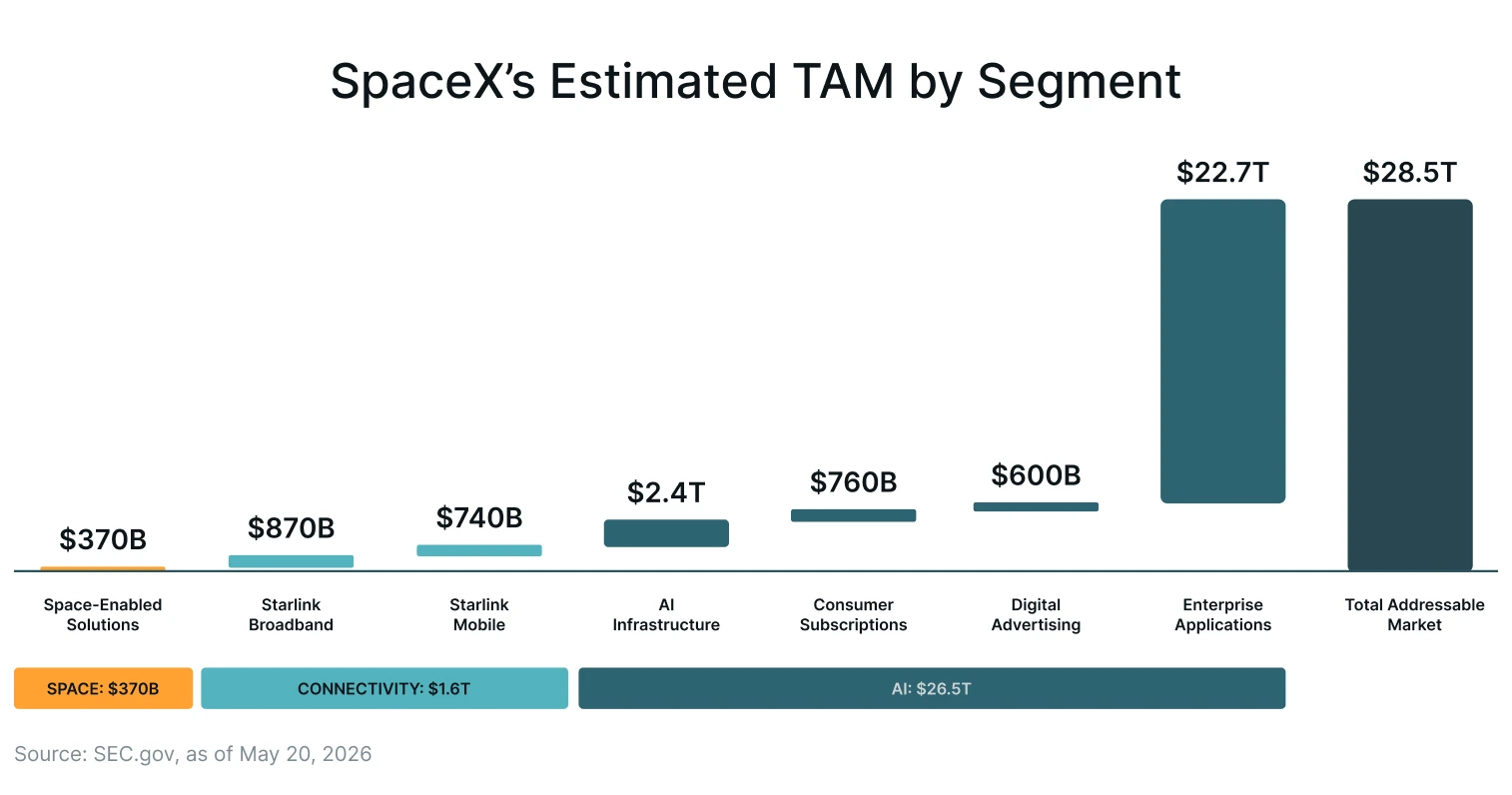
Looking ahead, there is considerable growth potential in this area of the business. SpaceX believes that its total addressable market (TAM) in Connectivity is $1.6 trillion ($870 billion in Starlink Broadband and $740 billion in Starlink Mobile), so we could see prolific growth in this segment in the years ahead as consumers and businesses embrace the company’s offering.1
It’s worth noting that Starlink has signed connectivity deals with a number of major airlines recently. For example, in May, it signed a deal with American Airlines to equip over 500 narrow-body aircraft with Starlink systems.2

Unrivalled AI Infrastructure Capabilities
Another fundamental component of the SpaceX bull case is artificial intelligence. Here, the company is rapidly constructing AI compute infrastructure on earth with the goal of extending the buildout to space as soon as 2028.
The rationale behind this goal is that AI infrastructure in space can utilize the power of the Sun. SpaceX believes that AI compute satellites in Sun-synchronous orbit will be able to handle energy-intensive AI workloads at far greater scale and efficiency than terrestrial alternatives.
In terms of data transfer, Starlink would be the enabler. It would provide low-latency, global connectivity, linking orbital AI systems to consumers and businesses around the world.
Looking beyond AI infrastructure, SpaceX is a major player in the AI model space as well as it recently acquired and absorbed xAI – the startup behind the Grok LLM (and the owner of social media platform X). The company says that by owning the compute infrastructure and vertically integrating across the full AI stack, it can train and iterate its frontier models at lower cost and higher velocity and accelerate development cycles.

Dominance of Commercial Launch Markets
SpaceX’s dominance on the orbital launch front is also an important part of the investment case. Since 2023, it has launched more than 80% of mass to orbit for the world each year (with an over 99% mission success rate with its Falcon rockets), which suggests that it has a near monopoly over global launch services.1
To date, it has completed approximately 650 orbital space launches – far more than any other commercial space company. As of March 31, 2026, it had launched a total mass to orbit of approximately 7,400 metric tons.1

It’s worth pointing out that while most of the hardware that SpaceX puts into orbit is its own, it deploys payloads for other customers too. For example, in 2025, it launched 24 satellites into orbit for Amazon3.
One major customer on the launch front is the US government. In 2025, the company secured a $5.9 billion Pentagon contract for 28 national security space launches through 20294.
An Unprecedented TAM
The overall TAM here is another fundamental component of the bull case. SpaceX believes that it has identified the “largest actionable TAM in human history” at $28.5 trillion.1
Breaking it down, this TAM consists of:
$26.5 trillion in AI: $2.4 trillion in AI infrastructure, $760 billion in consumer subscriptions, $600 billion in digital advertising, and $22.7 trillion in enterprise applications1
$1.6 trillion in Connectivity: $870 billion in Starlink Broadband and $740 billion in Starlink Mobile as well as additional opportunities in enterprise and government1
$370 billion in Space from space-enabled solutions1
Note that the company has excluded China and Russia from its global estimates.

SpaceX Has Scarcity Value
Finally, one other factor to highlight is SpaceX’s scarcity value. Today, there is nothing else like it in the public markets.
This is a frontier asset offering exposure to a range of high-growth industries. Because it integrates global connectivity, a massive AI infrastructure footprint, and government contracts, it sits alone at the intersection of deep tech, macro infrastructure, and geopolitical utility.
A New Investment Frontier
Putting this all together, the upcoming SpaceX IPO isn’t just a milestone for the public markets; it’s a paradigm shift. When SPCX stock hits the Nasdaq on June 12, it will land as the ultimate scarcity asset.
With its unparalleled scale and vertical integration, SpaceX is building a technology platform for the future, meaning that it is a true frontier asset. For investors looking to capture deep-tech megatrends, June 12 could mark the beginning of a whole new investment frontier.
SpaceX: 5 Eye-Opening Stats1
SpaceX estimates that its total addressable market (TAM) is $28.5 trillion
In 2025, SpaceX generated revenue of $18.7 billion
Since 2023, SpaceX has launched more than 80% of mass to orbit for the world each year
As of March 31, 2026, there were approximately 9,600 Starlink broadband and mobile satellites in low Earth Orbit
Today, Starlink provides internet connectivity to over 10 million subscribers globally
Footnotes:
1SEC.gov, Space Exploration Technologies Corp, as of May 20, 2026
2News AA.com, American Airlines to install Starlink, the fastest Wi-Fi in the sky, as of May 26, 2026
3Aviation Week by Informa, SpaceX Launches 24 Satellites For Rival Amazon Kuiper Network, as of July 16, 2025
4Reuters, SpaceX, ULA, Blue Origin clinch $13.5 billion-dollar Pentagon launch contracts, as of April 5, 2025
Author is a contractor of Leverage Shares LLC, a U.S. affiliate of Themes Management Company LLC. Leverage Shares LLC provides certain services to Themes under an intercompany services agreement.