
Article by Edward Sheldon
The SaaS Renaissance: 3 Factors Driving Software Stocks Higher
September 24, 2026 | Research
When software stocks experienced a huge sell-off earlier in the year amid AI disruption fears (the “SaaSpocalypse”), we highlighted the fact that many Wall Street firms viewed the sell-off as illogical. At the time, the general consensus within the analyst community was that the disruption fears were overblown and that many software companies would actually benefit from AI.
Fast forward to today, and it looks like analysts were right to remain constructive on the software sector as the S&P 500 Software & Services index has recovered its 2026 losses and is now roughly flat for the year1. Here’s a look at three key factors driving the rebound in software stocks.
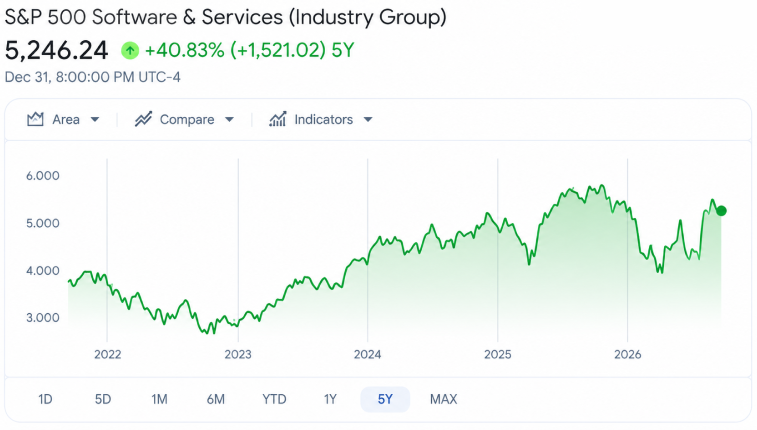
Source: Google Finance, as of September 18, 2026
Cybersecurity Stocks Are on Fire
One major factor behind the rebound in software has been strength across the cybersecurity sector. In recent months, this sector has rallied sharply on the back of heightened vulnerabilities and new attack vectors introduced by generative AI, which have forced enterprises to urgently upgrade their security stacks.
Some individual stocks worth highlighting here include CrowdStrike, Palo Alto Networks, Fortinet, and Rubrik. Recently, all have rallied to new all-time highs1.

Zooming in on CrowdStrike, it recently posted strong earnings for the second quarter of its fiscal 2027 year with growth in net new annual recurring revenue (ARR) accelerating to 51% year-over-year2. Given the strong quarter, the company raised its full-year guidance.
Since this earnings report, numerous Wall Street firms have raised their price targets for the cybersecurity stock3. Price targets have also been increased for other stocks in the space such as Palo Alto Networks, Zscaler, and Okta3.
Continued Strong Earnings Across the Sector
Another key driver of the rebound has been strong earnings from companies that operate in areas such as data management and data analytics. In these areas of software, numerous businesses have actually seen an acceleration in growth as customers have scrambled to clean, structure, and modernize their datasets to build and deploy enterprise generative AI applications.
One example here is Palantir, which helps organizations integrate, manage, and analyze disparate datasets to deploy customized, domain-specific AI models using its Artificial Intelligence Platform (AIP). Its most recent earnings showed 93% year-over-year revenue growth with US commercial revenue rising 149% year-over-year4.
Another example is Snowflake, which provides a cloud-native data platform that enables organizations to store, unify, and run advanced AI workloads directly on their enterprise data. Its most recent quarter showed year-over-year product revenue growth of 37% with a net revenue retention rate of 126% – signaling that customers are spending more5.

Note that both Palantir and Snowflake raised their full-year guidance in their most recent earnings. This led to price target hikes from Wall Street firms3.
Software Companies Are Having Success with AI Features
Finally, there’s the fact that many software companies have been having success with AI features. From customer relationship management companies like Salesforce to enterprise productivity firms like Atlassian, AI has become a core product driver that is unlocking new monetization streams through high-margin add-ons and subscription tiers.
Looking at Salesforce – which was highlighted by analyst Dan Ives earlier in the year as a stock that had been unfairly punished – it recently delivered a beat-and-raise driven by strong demand for its AI solutions. For the quarter ended July 31, its Agentforce and Data 360 ARR was nearly $3.9 billion, up over 210% year-over-year6.
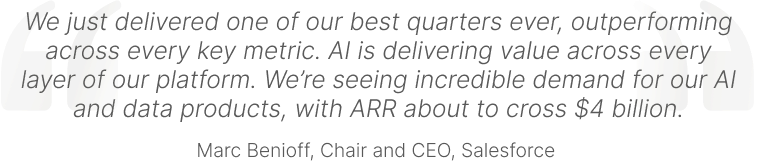
It’s worth noting that Salesforce recently launched a new AI product called Claudeforce in conjunction with Anthropic7. This is designed to enable organizations to put their data to work inside Claude – governed by the permissions and business rules the company already runs on.
Salesforce also recently increased its fiscal 2030 revenue target to $63 billion from $60 billion8. This has led to numerous price target hikes from Wall Street firms3, with many institutions going to $300.
The Generative AI Opportunity
In summary, the "SaaSpocalypse" sell-off proved to be a buying opportunity rather than a structural shift away from enterprise software. Driven by surging demand for AI-based cybersecurity, strong earnings, and successful AI feature monetization, the software sector has rebounded sharply.
Far from displacing software, generative AI appears to be actively powering the industry’s next multi-year growth cycle. For those who recognized that the sell-off was illogical and took advantage of the weakness across the sector, the massive rebound in recent months has translated into outsized gains.
Footnotes:
1Google Finance, as of September 18, 2026
2Crowdstrike, CrowdStrike Reports Second Quarter Fiscal Year 2027 Financial Results, as of August 26, 2026
3Investing.com, as of September 18, 2026
4Palantir, Palantir Reports Q2 2026 U.S. Comm Revenue Growth of 149% Y/Y and Revenue Growth of 93% Y/Y; Raises FY 2026 Revenue Guidance to 82% Y/Y Growth and U.S. Comm Revenue Guidance to 134% Y/Y, Crushing Consensus Expectations, as of August 3, 2026
5Snowflake, Snowflake Reports Financial Results for the Second Quarter of Fiscal 2027, as of September 2, 2026
6Salesforce, Salesforce Delivers Record Second Quarter Fiscal 2027 Results, as of August 26, 2026
7Salesforce, The #1 AI meets the #1 CRM. Welcome to Claudeforce, as of August 26, 2026
8CNBC, Salesforce issues revenue target of over $63 billion for fiscal 2030, beating estimates, as of September 16, 2026
Author is a contractor of Leverage Shares LLC, a U.S. affiliate of Themes Management Company LLC. Leverage Shares LLC provides certain services to Themes under an intercompany services agreement.