Few technological transformations carry the breadth of economic consequence now unfolding in the robotics and automation sector. From factory floors to rehabilitation clinics, from autonomous warehouses to humanoid assistants navigating hospital corridors, intelligent machines are rapidly transitioning from experimental novelty to industrial infrastructure.
The shift is being driven by a convergence of forces that rarely align in a single sector at the same time: rapid market expansion, structural labour shortages, advances in AI and hardware, accelerating capital formation, and the emergence of a broad supply chain supporting the next generation of intelligent machines.
In our view, the Themes Humanoid Robotics ETF (BOTT) is designed to provide exposure to this shift.
By attempting to provide diversified exposure to these companies, BOTT may allow investors to participate in companies that generate at least 50% of their revenues from humanoid & service robotics, industrial & autonomous robotics, assistive & wearable robotics, ai & cognitive robotics, and robot mobility, actuation & mechatronics.
Key Takeaways
The global humanoid robotics market is projected to grow from $5.4 billion in 2026 to $50.3 billion by 2035, alongside a sharp increase in annual shipments.
Labour shortages and ageing populations could support demand for physical automation, with logistics, automotive, and manufacturing expected to account for most near-term humanoid installations.
Investment and commercial deployment are accelerating, with robotics and physical AI attracting $26 billion in venture capital in 2025 and companies expanding production, funding, and industrial deployments.
1. A Market on Track for Rapid and Sustained Expansion
The market opportunity for humanoid robotics begins with the scale and trajectory of the addressable market.
The humanoid robot market is estimated at $5.41 billion in 2026 and projected to reach $50.27 billion by 2035, representing a 28.1% compound annual growth rate.1 Growth is expected to be driven by deployment across personal assistance, caregiving, healthcare, manufacturing, retail and logistics, alongside government initiatives across Asia Pacific, North America and Europe.1
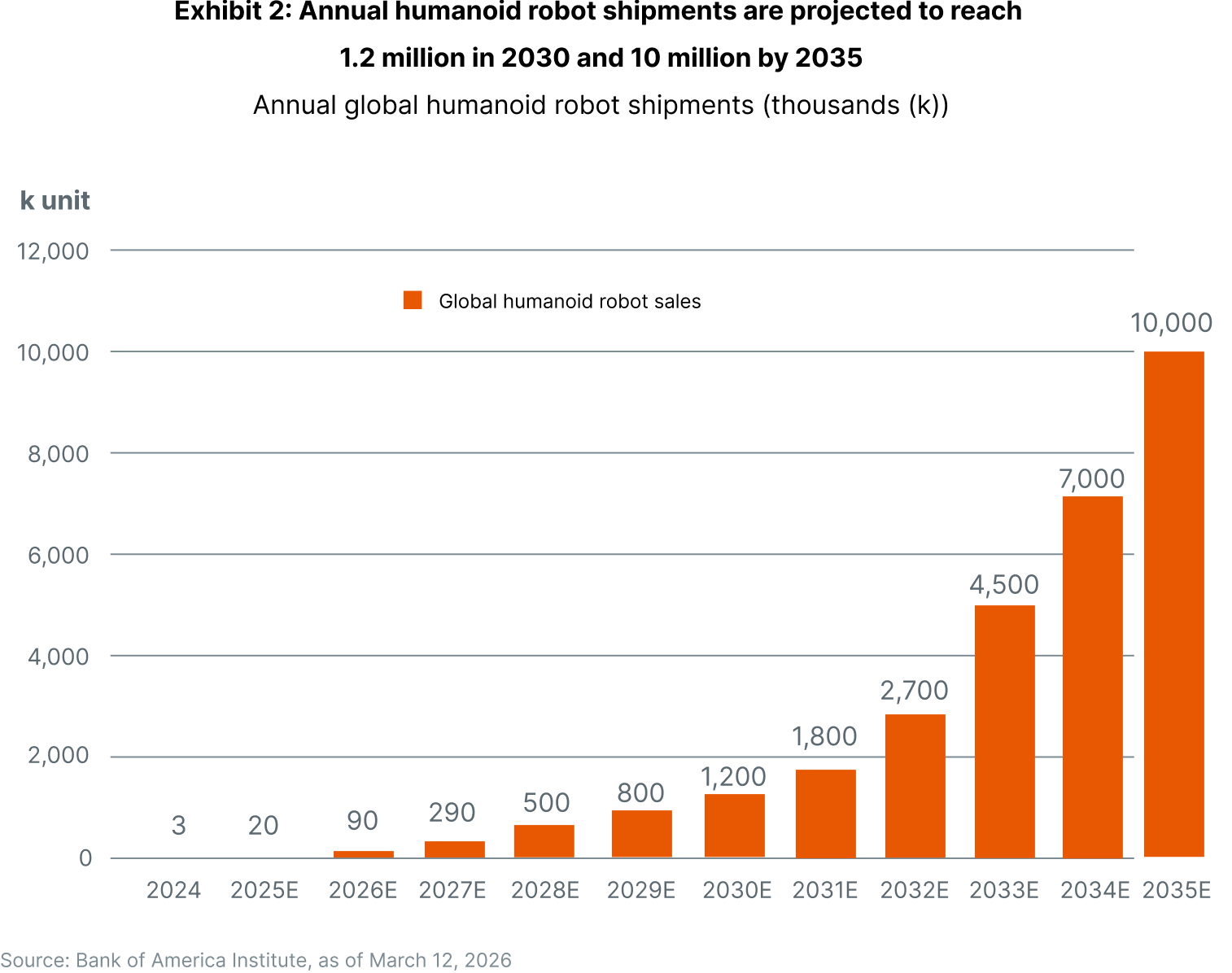
Unit projections point to a substantial increase in shipments. Annual humanoid shipments are forecast to rise from approximately 20,000 units in 2025 to 10 million by 2035 - an estimated 86% CAGR. Shipments are projected to reach around 90,000 units in 2026 and 1.2 million by 2030.2 By 2040, the global humanoid population is expected to reach 300 million units, rising to three billion by 2060, with household robots ultimately representing approximately 62% of the installed base.2
The near-term opportunity, however, is likely to be industrial rather than household. By 2027, an estimated 72% of humanoid installations are projected to be in logistics (33%), automotive (24%) and manufacturing (15%).2 These environments are relatively structured, allowing robots to be trained faster and operate with greater reliability.
Hazardous and physically demanding work represents another potential application for humanoid robots. Goldman Sachs expects the technology to find use in environments where robots can perform tasks that are difficult or dangerous for humans.3
Over time, the addressable market could broaden into retail, healthcare, education and home assistance. Household humanoids are projected to represent the majority of the global installed base by 2060.2
2. Labour-Force Constraints Create a Structural Customer Need
The industrial use cases outlined above are being reinforced by a structural economic pressure: businesses increasingly need to automate physical tasks as labour becomes harder to find. Across major economies, ageing populations are shrinking the pool of working-age people even as demand for healthcare, logistics and assisted-living services rises.
This pressure is particularly relevant to physical labour. Software, data processing and knowledge work have undergone rapid automation, but factories, warehouses and care facilities still rely heavily on people for tasks requiring mobility, dexterity and physical presence. These are also the environments where humanoid deployment is expected to begin, creating a direct link between labour scarcity and the early use cases for the technology.
The demographic data reinforces the scale of the challenge. The old-age dependency ratio is projected to reach unprecedented levels across most advanced economies over the next 35 years. Without significant changes in behaviour and policy, GDP per capita growth is likely to slow materially as labour shortfalls compound.4 The share of people aged 65 and older is projected to nearly double in countries whose populations have already peaked, rising from 17% in 2024 to 33% in 2054. Globally, people aged 65 and older are expected to surpass the number of children under 18 by the late 2070s.5
Research also shows that new robotic technologies are deployed more rapidly in countries where young and middle-aged workers are relatively scarce - a documented response to labour-supply constraints.6 Companies in China and South Korea are already responding to similar pressures, with 53% of businesses in Eastern Asia citing talent shortages as a key barrier to transformation.7
For investors, the implication is that robotics could help a smaller working-age population support greater output and more services. Humanoids are particularly relevant because their human-like form allows them to operate in existing warehouses, factories, hospitals and commercial buildings without requiring those environments to be redesigned. This could allow deployment in existing facilities without extensive changes to their physical infrastructure.2
This does not mean humanoids will replace workers broadly or quickly. The technology still faces challenges involving safety, reliability, energy consumption, dexterity, training, maintenance and return on investment. Near-term adoption is expected to remain concentrated in industrial environments where the productivity case is clearest and variability is lowest.2
3. AI and Hardware Advances Are Improving Robot Capabilities
Earlier generations of robotics were largely limited by their ability to operate in controlled environments. Robots could perform precise, repetitive movements, but adapting to changing conditions often required additional programming. Recent advances in AI are expanding the range of tasks robots may be able to perform.
The emergence of generative AI and large language models has contributed to the development of “embodied intelligence” - AI systems designed to interpret information from the physical world, respond to natural-language instructions and adapt to different environments.2
Vision-Language-Action (VLA) models are another development in this area, with research and industry applications exploring whether robots can learn tasks from demonstrations rather than relying entirely on specialist programming.8 These developments could reduce some of the software constraints that have historically limited more flexible robotics applications.
Hardware costs are also expected to decline as production scales. Built-in-China bill-of-materials costs were approximately $35,000 per unit in 2025 and are projected to fall below $17,000 by 2030.2 Another estimate puts costs at around $200,000 per unit in high-income countries in 2024, declining to approximately $150,000 by 2028 and $50,000 by 2050.9
However, significant technical and commercial uncertainties remain. Challenges include limited manipulation data, human-level dexterity, battery life, reliability and performance in unstructured environments. The pace at which these constraints are addressed will influence how quickly humanoid robotics can expand beyond controlled industrial applications.
4. Commercial Deployment and Capital Formation Is Accelerating
Capital is increasingly flowing into robotics and physical AI as companies move from development towards commercial deployment.
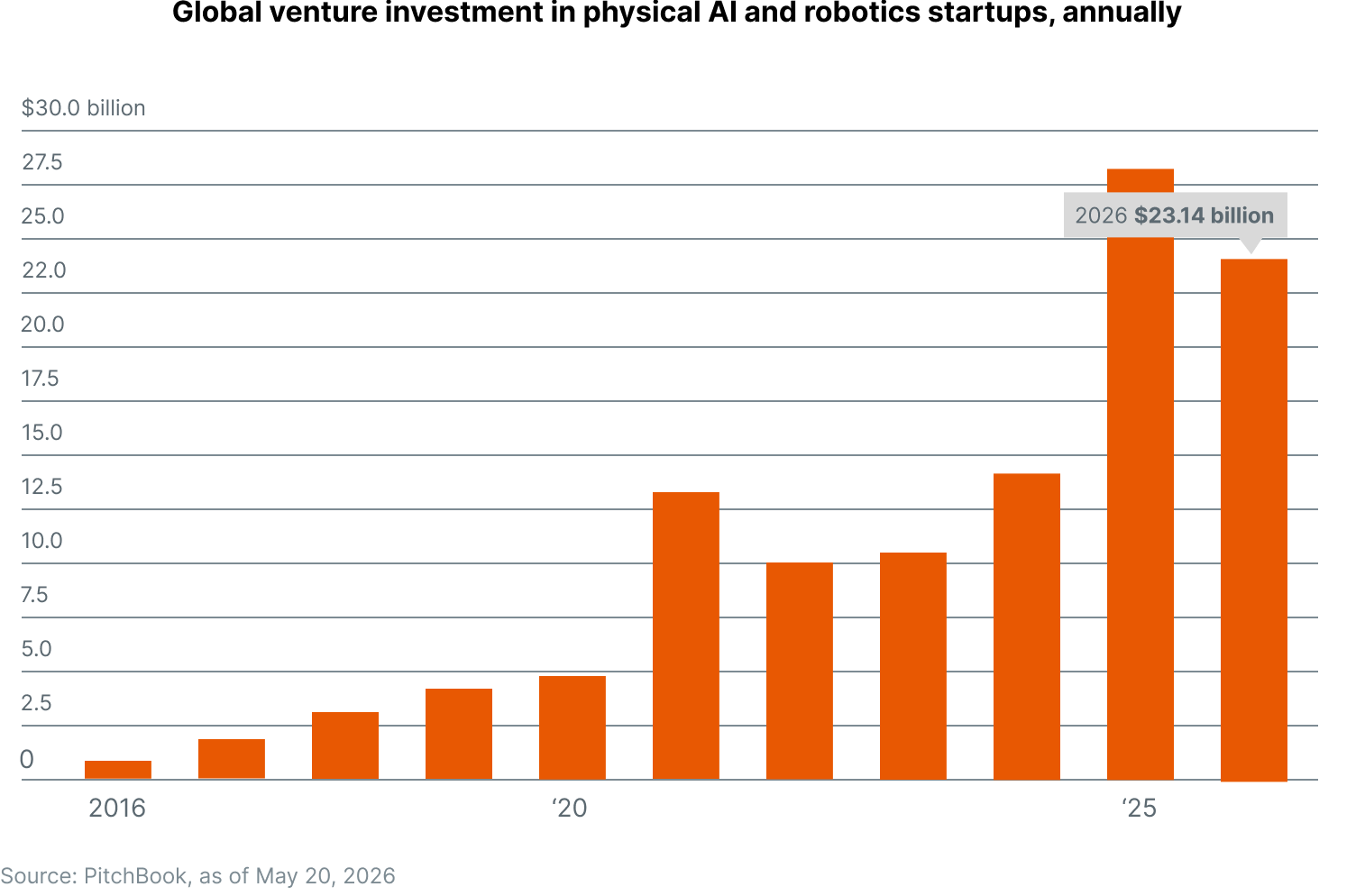
Venture-capital investment in global robotics and physical AI reached $26 billion in 2025, up from $4.2 billion in 2019, according to PitchBook data reported by The Wall Street Journal. By May 20, 2026, companies in these sectors had already raised more than $23 billion.10
Funding for humanoid robotics has also increased. Dealroom data showed that humanoid robotics startups attracted $8.6 billion in funding during the first half of 2026.11 More than 50 companies also were reportedly developing humanoid robots by January 2026, with around 150 commercial launches recorded by then.2
As development progresses towards commercialisation, several companies are now establishing production capacity. XPeng commissioned its humanoid robot production lines in September 2026, with its IRON robot completing production on the new lines. The company plans to begin mass production by the end of 2026, with market launch and deliveries in China and overseas markets planned for 2027.12
Tesla is also preparing for volume production of Optimus. Preparations for its first production line are underway, with production planned to begin before the end of 2026 and eventual planned capacity of 1 million robots per year.13
Other companies are pursuing different routes towards commercialisation. Figure AI has raised more than $1 billion in Series C funding at a reported $39 billion post-money valuation, with investors including NVIDIA, Intel Capital and Salesforce.14
The sector is also beginning to extend into public markets. Agility Robotics announced a proposed $2.5 billion combination with Churchill Capital Corp XI, subject to shareholder and regulatory approvals.15
Meanwhile, commercial deployments are moving into industrial settings. BMW Group reported using a humanoid robot at its Spartanburg production facility, where it supported the manufacture of more than 30,000 vehicles over an 11-month deployment by performing sheet-metal insertion for welding processes. Following the pilot, BMW expanded the programme to a next-generation robot and additional logistics tasks.16
The industry is therefore moving from funding and development towards production and real-world deployment. As more robots enter operating environments, data from these deployments should provide greater visibility into reliability, productivity, operating costs and the ability to scale across different industrial settings.
5. The Robot Is the Product. The Supply Chain Is the Investment.
The humanoid robotics ecosystem extends well beyond the companies building complete robots. Each machine requires a broad range of components and technologies, creating potential demand across multiple layers of the supply chain as production scales.
A humanoid robot requires tactile, force and proximity sensors for physical interaction. It needs actuators for movement and precision gears such as harmonic reducers and ball screws. Semiconductors provide computing power for real-time decision-making, while cameras, depth sensors and LIDAR enable environmental perception. Industrial software supports AI training, simulation and fleet management, while batteries and power-management systems determine operating duration between charges.
The semiconductor layer is one part of this supply chain. Each humanoid robot could contain approximately $3,000 to more than $6,000 of semiconductor content across computing, analog and mixed-signal chips and edge storage.3
Actuators could represent another significant share of the hardware value. Linear and rotary actuators are projected to account for more than 50% of total humanoid robot build cost by 2030.2 This could increase the importance of actuator suppliers as production scales. Similar dynamics could apply to precision gearing, sensor systems and industrial software.
The resulting ecosystem spans robotics hardware manufacturers, AI chip designers, precision component suppliers, industrial software companies, battery and power-management providers and system integrators. As the industry develops, the evolution of these individual layers will be closely linked to the pace at which humanoid production and deployment expand.
How to Play It
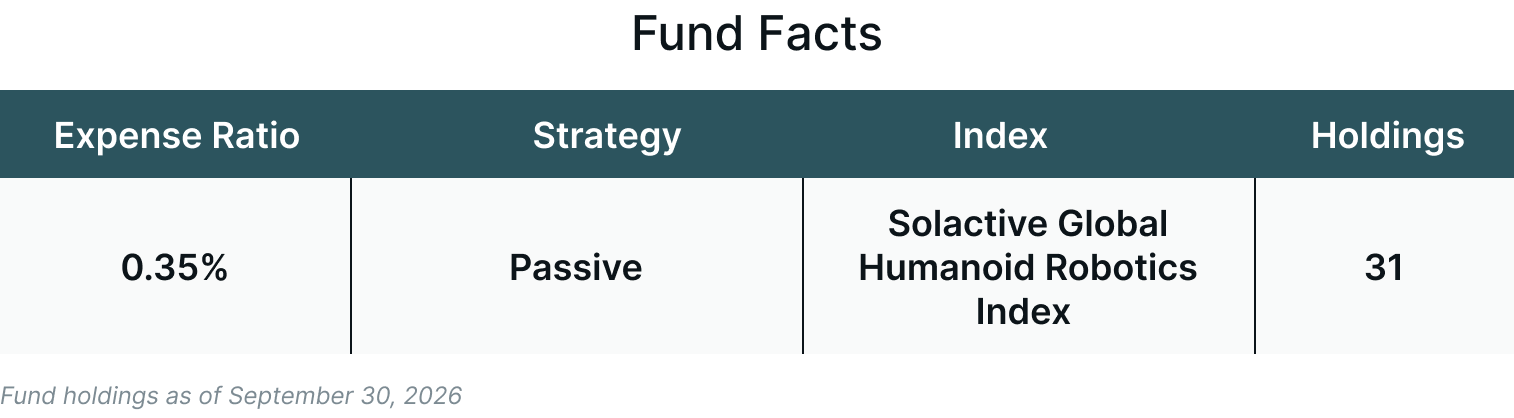
The Themes Humanoid Robotics ETF (BOTT) seeks to track the Solactive Global Humanoid Robotics Index (SOLGHRBN), which identifies companies that generate at least 50% of their revenues from activities in the following areas:
Humanoid & Service Robotics
Industrial & Autonomous Robotics
Assistive & Wearable Robotics
AI & Cognitive Robotics
Robot Mobility, Actuation & Mechatronics
BOTT seeks to provide investment results that correspond generally to the price and yield performance, before fees and expenses, of the SOLGHRBN Index.
Conclusion
Humanoid robotics is moving from an emerging technology towards a broader commercial ecosystem. Advances in AI and hardware are expanding what robots can do, while labour constraints are creating potential applications across factories, warehouses and other physically demanding environments. At the same time, rising investment and early commercial deployments are providing more evidence on how the technology performs outside controlled settings.
The next stage of development will depend on how these systems perform at scale. Reliability, dexterity, energy consumption, operating costs and productivity will determine the practicality of deploying humanoids across different environments. As companies move from pilots towards larger production volumes, real-world deployments should provide greater visibility into these factors and the economics of operating humanoid robots.
For investors, the theme extends beyond the companies building complete robots. Semiconductors, sensors, actuators, precision gearing, software, batteries and power-management systems all form part of the technology stack. As the industry develops, these interconnected layers will provide different points of exposure to the growth of humanoid robotics and the wider physical AI ecosystem.
For more information about the fund, including fees/expenses, holdings, standardized performance, risks and more, please visit https://themesetfs.com/etfs/bott
Footnotes:
1MarketsandMarkets, Humanoid Robot Market Size, Share & Trends, 2026 to 2035, July 2026
2Bank of America Institute, Physical AI, Part 2: Humanoid Robots, March 12, 2026
3Yahoo Finance, “Goldman Sachs Just Supercharged Its Humanoid Robot Prediction 5X to 6.5 Million by 2035,” September 14, 2026
4OECD, OECD Employment Outlook 2025: From Job Shortage to Labour Shortage, July 2025
5United Nations, World Population Prospects 2024, Department of Economic and Social Affairs, 2024
6National Bureau of Economic Research, Automation Can Be a Response to an Aging Workforce, NBER Digest, July 2018
7World Economic Forum, The Future of Jobs Report 2025, 2025
8Deloitte Insights, AI Goes Physical: Navigating the Convergence of AI and Robotics, Tech Trends 2026, December 10, 2025
9Morgan Stanley Research, Humanoids: A $5 Trillion Market, May 14, 2025
10The Wall Street Journal, Venture Capital Turns to Hardware Bets as AI Threatens Software Companies, May 2026; citing PitchBook data
11Tech Funding News, Top 10 humanoid robot startups to watch in 2026, July 24, 2026
12XPeng, IRON Humanoid Robot Now Walks Off the Production Line, September 8, 2026
13Tesla, Q4 2025 Update, January 28, 2026
14Figure AI, Figure Exceeds $1B in Series C Funding at $39B Post-Money Valuation, September 16, 2025
15Agility Robotics / Churchill Capital Corp XI, Agility Robotics to Go Public Through $2.5 Billion Merger with Churchill Capital Corp XI, June 24, 2026
16BMW Group, BMW Group advances the use of Physical AI in production with Figure 03 project in Spartanburg, June 25, 2026
Diversification does not eliminate risk.
Article by Ayesha Shetty
Author is a contractor of Leverage Shares LLC, a U.S. affiliate of Themes Management Company LLC. Leverage Shares LLC provides certain services to Themes under an intercompany services agreement.