Key Takeaways
Anthropic’s recent public disclosures revealed one of the most audacious capital structures in modern corporate history: hundreds of billions in multi-year compute and infrastructure commitments.
These commitments are distributed across a tight circle of hyperscalers, chip architects, and specialized infrastructure providers:
Amazon Web Services (AWS) via massive deployments of proprietary AWS Trainium silicon and Nvidia clusters.
Google Cloud via TPU (Tensor Processing Unit) reservations and co-located cloud infrastructure.
Broadcom & Custom Silicon Partners via massive forward commitments tied to co-designed ASICs, high-bandwidth interconnects, and networking fabric.
Microsoft Azure & Alternative Clusters via diversified compute redundant across regional grids and specialized architectures (including AMD clusters).
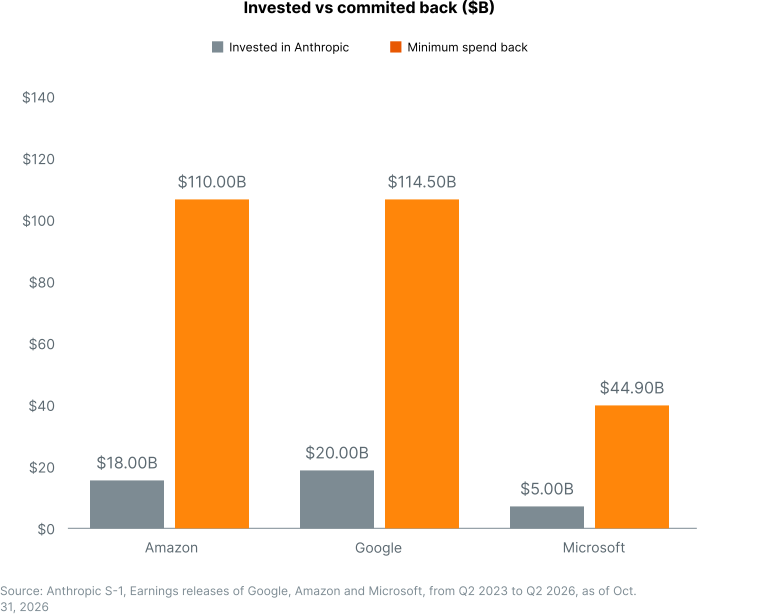
This arrangement was driven by quid-pro-quo arrangements wherein investments made into Anthropic by hyperscalers and providers led to infrastructure commitments: combined with the $8 billion it invested as revealed in its notes from 2023 through 2025, Amazon’s total investment in Anthropic amounts to about $18 billion while Anthropic committed to spending at least $110 billion on Amazon Web Services over the next decade. Google invested $20 billion during 2026 while Anthropic has committed to spend at least $114.5 billion with Google’s cloud business between April 2026 and July 2033. Microsoft and Nvidia invested up to $5 billion and $10 billion respectively, against which Anthropic has committed to spending at least $30 billion to use Microsoft’s Azure cloud. Broadcom has $42 billion in convertible notes (loans that can be turned into Anthropic shares), and its filings reveal the money can only be used strictly to pay rent on Broadcom’s own equipment.
Therefore, the investments cover roughly a sixth of what Anthropic has to pay back, and the rest has to come from real customer revenue.
All told, the circularity tilts in hyperscalers’ revenue leading to Anthropic’s business model having a distinct contractual mismatch:
A Fixed & Non-Cancelable Supply Side created via Anthropic’s supplier contracts, which contain rigid take-or-pay clauses and fixed multi-year minimum cash obligations – regardless of utilization.
A Variable & Consumption-Based Demand Side due to the vast majority of Anthropic’s enterprise revenue driven via API calls and cloud marketplaces. Customers are effectively free to swap from Claude to GPT or Gemini overnight with zero exit penalties.
An Anatomy of AI Compute
To understand the viability of these commitments, it is necessary to understand that AI compute cost is not simply the hourly rental price of a GPU. Instead, the stack consists of:
Hardware Depreciation: A chip cluster does not just lose physical life; it suffers economic obsolescence within 36 to 48 months as next-generation nodes offer 3–4× better FLOPs-per-watt efficiency. This means that while the likes of Meta, Amazon, Microsoft, Google, and Oracle are depreciating their Nvidia GPUs over five to six years the real economic life is closer to two or three.
Power Blocks: With millions of megawatts slated to be consumed in datacenters, power purchase agreements (PPAs), and power usage effectiveness (PUE) cooling ratios represent a rising floor of irreducible cash costs.
Networking Fabric: With massive multi-node distributed training and inference requiring high-radix optical transceivers and proprietary interconnects, this layer accounts for nearly 20–30% of total cluster capital expense.
Memory Footprint: Processing complex agentic workflows with long context windows requires vast pools of High Bandwidth Memory (HBM) to hold attention keys and values, which severely limits concurrent batch sizes and ramps up installation costs.
While custom silicon underpinning latest generation TPUs arguably don’t come with the often-cited 75% margin1 relative to manufacturing cost that Nvidia collects from GPU buyers, the fact remains that token costs do not adequately take into account all-in costs and are heavily cushioned by market-share warfare and circular capital:
Hyperscalers invest equity capital into AI labs, which immediately flows back to the hyperscalers as cloud compute revenue. This circular dynamic allows labs to price tokens near or below true economic cost to lock in developer mindshare.
Model providers could continually slash token prices per million tokens to drive enterprise adoption and outcompete open-source alternatives.
But there are signs that the discounting of true costs is beginning to crumble: on January this year, Amazon raised H200 GPU instance prices by 15%, marking the first GPU price increase in roughly two decades. In July came the second increase when it raised EC2 Capacity Block prices for Nvidia GPU instances by about 20%. While explained away as supply/demand dynamics, the fact that Google did the same – when holding steady would have yielded an advantage in a market share war environment – implies that this is policy. While Anthropic’s existing contracts are mostly fixed dollar commitments, the next tranche isn’t: the additional $125–150 billion of TPU compute for 2028–2031 depends on capacity, deployment, pricing and other conditions – thereby making future compute prices an open risk.
What Frontier Lab Metrics Show
Anthropic’s top-line revenue has exploded into the tens of billions, but the trajectory of its margin profile as reserved capacity goes live is where financial narratives diverge. Under standard GAAP accounting, frontier AI companies can show flattering gross margins (often 70–85%) because of how expenses are categorized:
Cost of Goods Sold (COGS): Primarily includes direct token-generation compute (active customer inference).
Research & Development (R&D): The titanic compute expense dedicated to pre-training and post-training frontier models sits safely below the gross profit line in R&D.
Sales & Marketing (S&M): Platform revenue shares paid out to channel partners (AWS Bedrock, Google Vertex AI) often sit in S&M rather than cost of sales.
When looking at all-in cash burn relative to total compute consumed, operating margins tell a much tighter story. Research and development costs – under which model training is ensconced – totalled $9.7 billion in the first half of 2026. Meanwhile, the fees that Anthropic pays to Amazon, Alphabet, and Microsoft to sell Claude on their cloud platforms – which gets accounted for under the heading of sales and marketing – totalled $3.8 billion. Anthropic's operating expenses rose from $3.3 billion in the first half of 2025 to $17 billion in the first half of 2026. Thus, the nearest approximation of the all-in cost of compute might be more realistically captured in the GAAP operating margin, which clocked in at 8%. Anthropic warned in its S-1 that it expects its operating margin to fluctuate over time, and that it will be affected by the company's compute expenses and the timing of those expenses. When massive tranches of compute are engaged, costs land in one fell swoop, which means that margins could compress if revenue growth doesn't keep up.
When gigawatts of planned capacity come online:
If adoption accelerates (The “Bull Case”), high-volume inference drives unit costs down, amortizing pre-purchased capacity across billions of daily tokens and expanding cash-flow margins.
If demand plateaus or shifts (The “Bear Case”) and revenue growth slows from 1000% to 30–40%, fixed compute drag acts as an anchor – with depreciation schedules on leased clusters, cooling contracts, and take-or-pay cloud bills instantly compressing operating margins and turning paper operating income into steep cash deficits.
What Could Be the Road Ahead
If capital markets continue demanding sustainable standalone cash returns – as SpaceX CEO Elon Musk indicated2 during the Q3 2026 earnings call – the industry will experience a structural pricing shift:
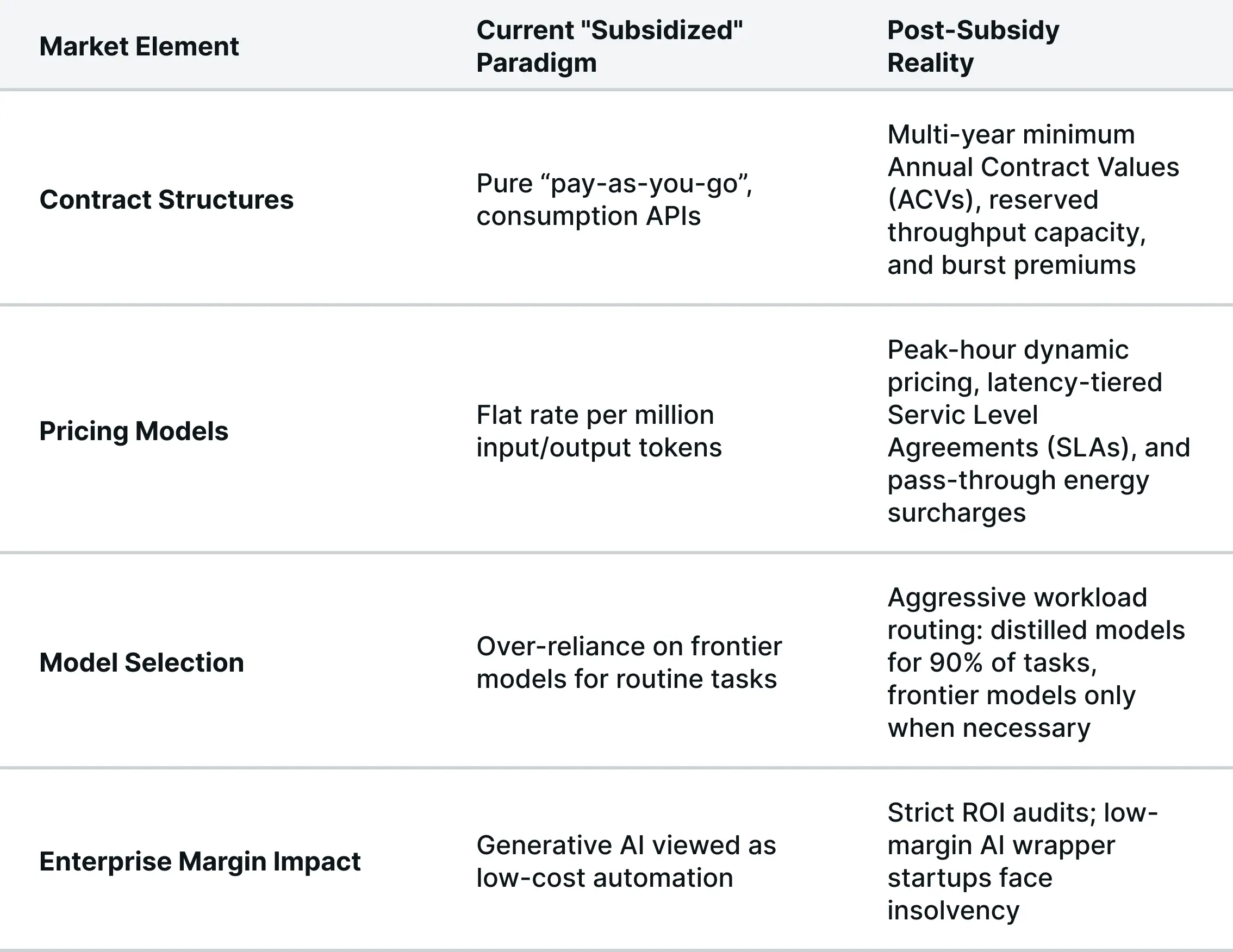
The post-subsidy reality is what might be driving the declining cost of tokens in the face of new models being unveiled. It wouldn’t be far-fetched to argue that Anthropic has wagered the entire enterprise on Jevons Paradox—that drastically reducing the cost and latency of intelligence will spark an exponential wave of demand so large that it easily absorbs hundreds of billions in infrastructure.
However, it bears noting that estimates3 peg the top 1% of Anthropic’s customers making up nearly 50% of its revenue, with B2B retention of 87% after 12 months and 95% after 24. If intelligence becomes a commoditized utility before Anthropic converts consumption into long-term customer lock-in, the company risks holding the bill for the world's most expensive, rapidly depreciating computational real estate.
This doesn’t necessarily mean that Anthropic’s IPO will be a bust: institutional asset managers will scramble to buy stake for their funds in the interests of coverage, arbitrageurs will position for the hype, and retail investors – being courted more aggressively than ever before in the wake of SpaceX’s IPO – will vote on the price with their pocketbooks. What will follow, however, will be adjustments as asset managers offload to account for the necessary symbiosis between lab and hyperscaler (not to mention the stakes either hold in the other), more complexity in the interpretation of AI’s utility and the conviction in the three-year-long AI Hype. The Q3 2026 earnings season – during which Anthropic had filed its S-1 filing during – has shown AI-relevant stocks floundering within three trading session despite posting massive earnings growth.
Anthropic’s IPO will thus be a bellwether for potentially a long list of AI labs to come.
Footnotes:
1“Nvidia earnings takeaways: Huang forecasts 70% fiscal 2028 revenue growth, far above estimates”, CNBC, 27 August 2026
2“Elon Musk says more than 200 neoclouds face ‘guppy-level death’”, CNBC, 26 October 2026
3“YipitData Releases Anthropic Pre-IPO Analysis, Examining Adoption, Spending, and Competitive Trends”, BusinessWire, 27 October 2026
Author is a contractor of Leverage Shares LLC, a U.S. affiliate of Themes Management Company LLC. Leverage Shares LLC provides certain services to Themes under an intercompany services agreement.