Few groups of companies sit as close to the centre of the global economy as global systemically important banks (G-SIBs). These banks clear payments across borders, underwrite the debt and equity that fund corporate investment, hold trillions in household deposits and play a central role in the transmission of monetary policy.
Their size, complexity and interconnectedness mean that their failure could pose risks to the wider financial system. As a result, they are subject to some of the most stringent capital, resolution and supervisory requirements in global banking. This combination of economic reach and systemic importance sets them apart from the broader banking sector.
According to the Financial Stability Board (FSB), 29 banks were designated as G-SIBs in 2025.1 They are headquartered across ten countries in North America, Europe and Asia, reflecting the international reach of the institutions that underpin the global financial system.
In our view, the Themes Global Systemically Important Banks ETF (GSIB) offers exposure to this segment of the global banking industry, providing investors with access to institutions that play a central role in the functioning of financial markets worldwide.
Key Takeaways
G-SIBs include the world's largest banks by assets and are identified annually through a published, indicator-based methodology, creating a defined universe of 29 banks subject to additional capital, resolution and supervisory requirements.
Capital levels among large banks remain robust, with all banks remaining above their minimum CET1 requirements under a hypothetical severe recession scenario.
G-SIBs generate revenue across lending, capital markets, payments and other financial services, while their international networks support cross-border finance.
1. Exceptional Scale and Global Economic Reach
G-SIBs operate at a scale few other financial institutions can match, with activities spanning multiple countries, financial markets and critical infrastructure.
As of the end of 2025, Industrial and Commercial Bank of China (ICBC) was the world's largest bank by assets, with $7.646 trillion in assets, 14.7 million corporate clients and 782 million personal customers. China's three other major state-owned lenders ranked next, followed by JPMorgan Chase, Bank of America, BNP Paribas and HSBC, all of which are G-SIBs.1,2
However, size alone does not determine whether a bank is systemically important. Each year, the FSB, in consultation with the Basel Committee on Banking Supervision (BCBS) and national authorities, identifies G-SIBs using an indicator-based methodology, supplemented by supervisory judgement, that assesses banks across five broad categories: size, interconnectedness, substitutability or financial infrastructure, complexity and cross-jurisdictional activity.1,3
Several of these measures capture the breadth of a bank's activities beyond its home market. Cross-jurisdictional activity measures a bank's claims and liabilities outside its home country, while substitutability considers activities such as payments, assets under custody and debt and equity underwriting.3 Through these activities, G-SIBs serve multinational corporations, institutional investors and governments across markets, linking them to cross-border trade, capital flows and payment systems.
G-SIB designation therefore tells investors more than a bank's size. It identifies institutions so embedded in the financial system that their distress could affect other banks and markets.
2. Capital Strength Built Over More Than a Decade
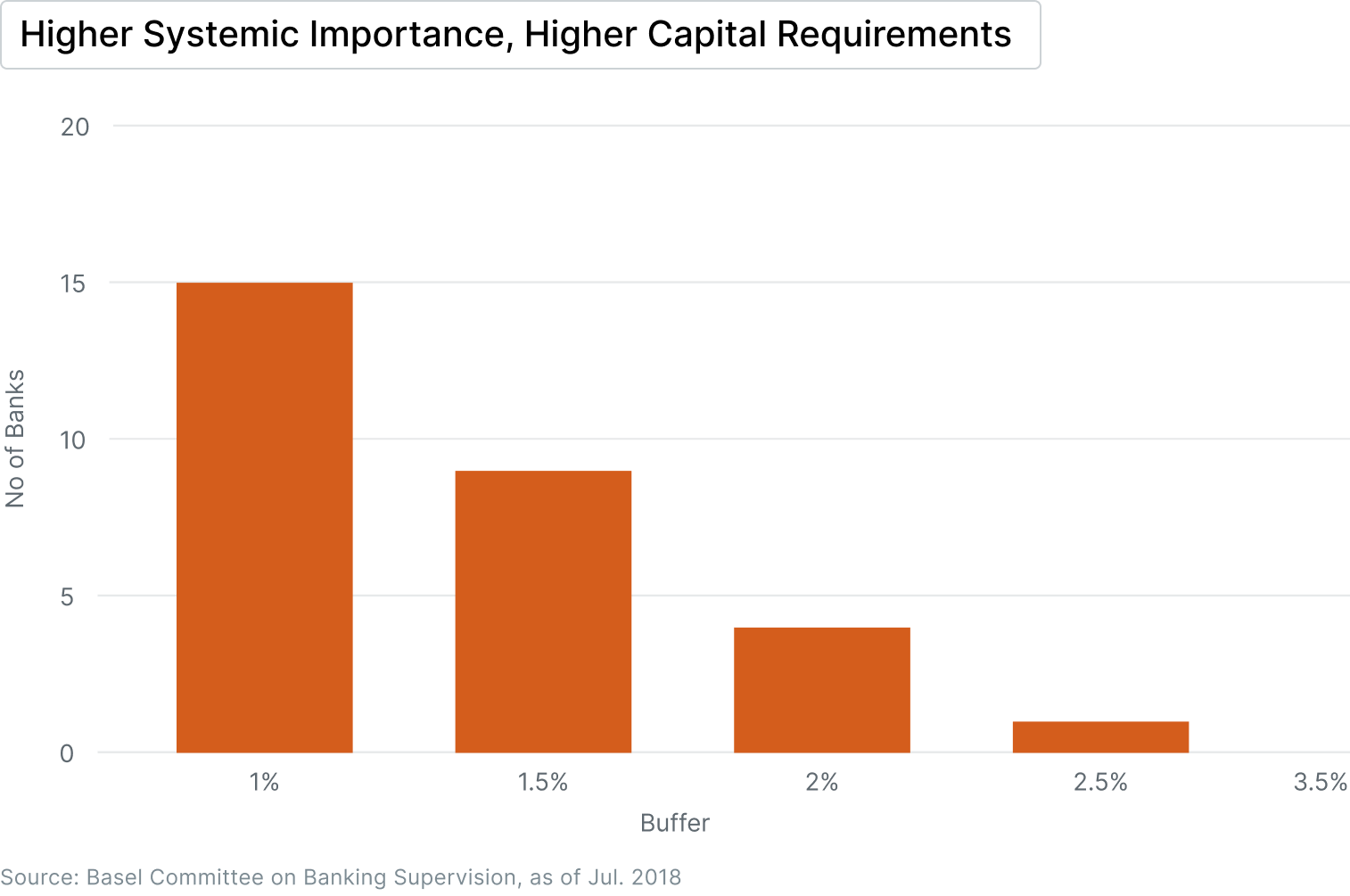
Since the global financial crisis, G-SIBs have been required to hold an additional CET1 capital buffer of 1.0% to 3.5% of risk-weighted assets, depending on their systemic importance. They must also meet the Total Loss-Absorbing Capacity (TLAC) standard and liquidity requirements, and maintain plans for an orderly resolution.1,4,5 Alongside broader Basel III reforms, these measures have contributed to a significant strengthening of the capital positions of the world's largest banks.
The Basel Committee's monitoring data illustrates the scale of this change. Between June 2011 and December 2025, CET1 capital held by large internationally active (Group 1) banks increased by 162.5%, from €1,320 billion to €3,465 billion. As of December 2025, their average CET1 ratio was 13.9%, well above the 4.5% Basel III minimum before additional buffers. The average fully phased-in Tier 1 leverage ratio for G-SIBs was 5.9%.5
Stress testing provides another indication of the resilience built into the system. In the Federal Reserve's 2026 stress test, all 32 large banks tested remained above their minimum CET1 requirements under a hypothetical severe recession. Despite absorbing more than $708 billion in projected losses, aggregate capital declined by only 1.6 percentage points. The scenario incorporated sharp declines in commercial real estate and house prices, alongside a significant rise in unemployment.6
Strong aggregate results do not mean every bank is equally resilient, however. Stress tests are hypothetical, and outcomes can vary significantly depending on a bank's balance sheet, loan mix and other exposures. The IMF's global stress test of 669 banks, covering about three-quarters of global banking assets, projected only a modest decline in the aggregate CET1 ratio under its adverse scenario, from 13.0% to 12.3%. Yet banks representing about 18% of global bank assets would fall below the IMF's 7% CET1 threshold for weak banks under the same scenario.7 Credit quality in areas such as commercial real estate and consumer lending, as well as banks' exposures to non-bank financial institutions, therefore remain important areas to monitor.
For investors, stronger capital buffers can help G-SIBs absorb losses while continuing to lend and maintain core operations during periods of financial stress. However, capital strength is only one measure of resilience. Credit quality, risk management and the ability to generate earnings through the cycle also influence how effectively banks withstand adverse conditions.
3. Multiple Earnings Engines Across Business Lines
G-SIBs generate earnings across a broad range of financial activities, reflecting the scale and breadth of their operations. Lending remains a core source of income, but large global banks also earn from investment banking, trading, wealth and asset management, payments and custody. This breadth can reduce reliance on any single business line and allow banks to participate in different parts of the financial cycle, although it does not eliminate earnings volatility when economic or market conditions deteriorate.
The scale of G-SIBs is particularly evident in both lending and capital markets. Their large balance sheets allow them to provide financing to major corporations and institutions, while their global distribution networks and regulatory presence enable them to underwrite large debt and equity offerings, advise on mergers and acquisitions and make markets for institutional investors.
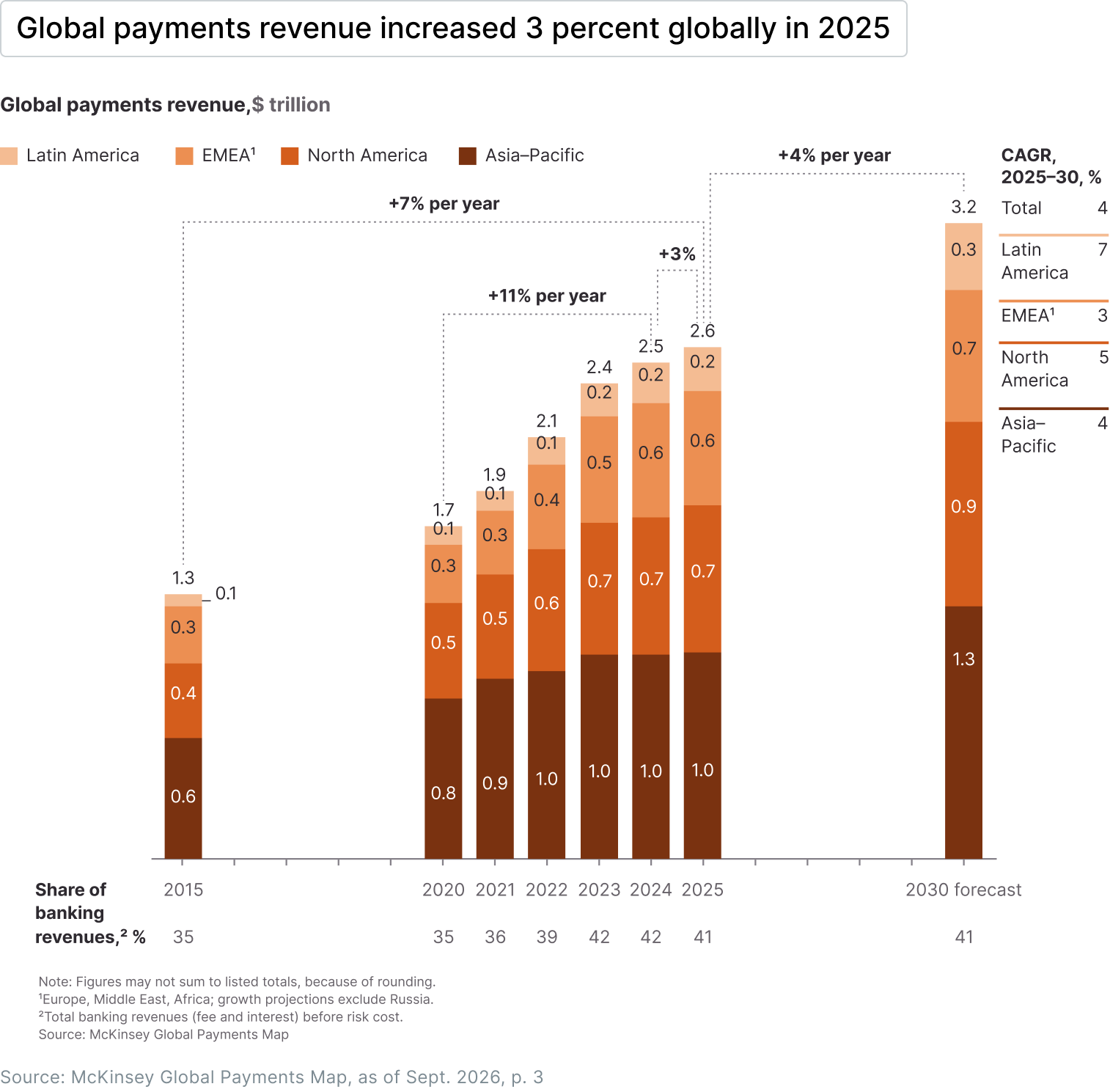
Payments and custody provide another important earnings stream. Large banks operate critical infrastructure for corporations, institutions and governments, generating fee income from transaction activity while also earning interest on some transaction balances. Payments generated about $2.6 trillion in revenue in 2025 from 3.8 trillion transactions and $2.1 quadrillion in annual value flows, equivalent to roughly 41% of total banking revenues. Revenue grew at an average annual rate of 9% between 2020 and 2025, although growth is expected to moderate to about 4% a year through 2030.8
Wealth and asset management add further sources of relatively recurring fee income. These earnings streams also respond differently to economic and market conditions. Lending income is influenced by interest rates, loan growth and credit quality; trading and investment banking revenues can be more sensitive to market activity and investor sentiment; while payments and custody are more closely linked to transaction volumes and assets serviced.
4. A Central Role in Expanding Cross-Border Finance
Cross-border finance is where the international networks of G-SIBs translate most directly into business. Companies operating across countries need banks that can move money between currencies and jurisdictions, finance international transactions and manage foreign-exchange and other financial risks.
Cross-border banking activity has continued to expand. Global cross-border bank claims reached $47.6 trillion at the end of March 2026, while cross-border bank credit grew 11% year over year, with annual growth remaining positive in each of the previous five years.9 For G-SIBs with established international networks, this growth can create opportunities across corporate lending, transaction banking, payments and foreign-exchange services, although growth in financial flows does not automatically translate into higher bank profitability.
Results at individual G-SIBs show how this activity can feed into revenue. In 2025, Citi's Services business, which provides treasury, trade and securities services, grew revenue by 8%, while its cross-border transaction value rose 10%.10
Foreign exchange is another major component of cross-border finance. In 2025, HSBC processed around $500 trillion of payment transactions in 130 currencies, and reported that foreign exchange in its corporate and institutional banking business was one of the main contributors to its revenue growth.11
Trade finance provides another channel. Up to 80% of global trade is supported by some form of financing or credit insurance, including letters of credit, guarantees and supply-chain finance.12 Providing these services across jurisdictions requires correspondent banking relationships, local regulatory capabilities and systems for managing credit, sanctions and compliance risks, an area where G-SIBs' international networks can be an advantage.
The opportunity is not without risks. Trade tensions, sanctions and geopolitical fragmentation can reduce cross-border flows, redirect trade routes and increase compliance costs. Payment infrastructure is also changing. Payment stablecoins could reduce the reliance of some businesses and smaller banks on correspondent banking chains, potentially lowering intermediation fees and increasing competitive pressure on cross-border intermediaries. Large international banks may nonetheless retain a role, for example as counterparties that convert stablecoins into local currency and as providers of compliance checks across jurisdictions, and the overall effect will depend on regulation, cost and the pace of adoption.13
5. Diversification Across Banking Systems
The G-SIB universe is international by design. The group spans the United States, Canada, the United Kingdom, continental Europe, Japan and China.1 No single national banking system defines it.
This matters because bank earnings are shaped by local conditions. Interest-rate cycles, loan demand, regulatory regimes and competitive structures differ from country to country, and they rarely move in step. Japan's megabanks, for example, have benefited from the Bank of Japan's exit from negative interest rates,14 while the earnings of large US banks have been more closely tied to capital markets activity and domestic regulation, and China's state-owned lenders operate within a policy-directed credit system.
For a portfolio, this means exposure is not tied to a single country's interest-rate path, credit cycle or regulator. This geographic diversification is distinct from the business-line diversification described in Section 3. It spreads exposure across banking systems, but it does not necessarily reduce overall portfolio risk, since banks in different countries can still be affected by common global shocks.
Breadth brings its own considerations. International bank holdings introduce currency risk, differences in accounting standards and exposure to political and economic conditions in each market, including emerging markets such as China. These factors can cause returns across regions to diverge significantly over any given period.
How to Play It
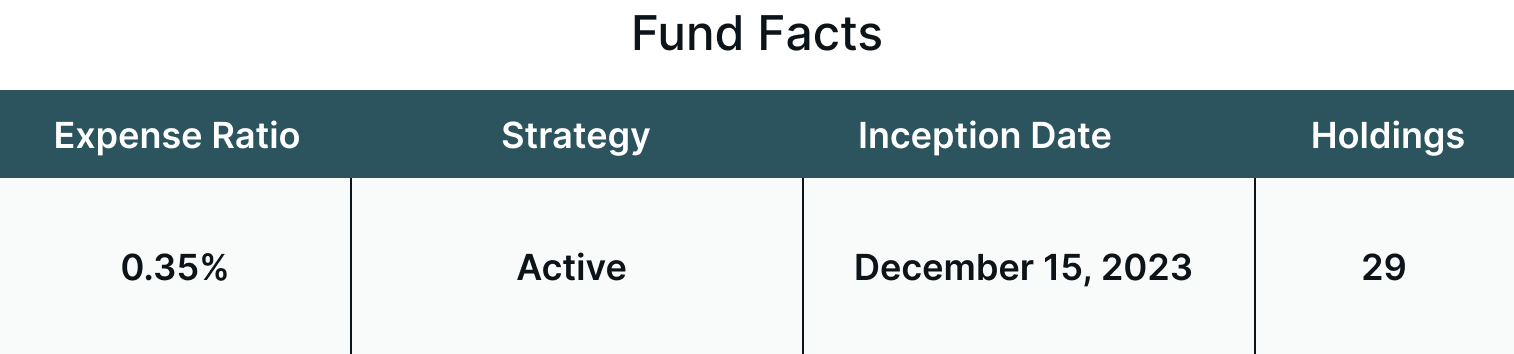
The Themes Global Systemically Important Banks ETF (GSIB) is an actively managed fund that invests in the publicly traded banks included in the FSB's annual G-SIB list, which is compiled using the BCBS assessment methodology.
A bank is deemed systemically important due to its size, interconnectedness, financial infrastructure, complexity and cross-jurisdictional activity.
Conclusion
The case for the world’s largest banks is ultimately about the durability of their position within the financial system. Their competitive advantages have been built over decades through scale, client relationships, infrastructure, regulatory expertise and the ability to operate across markets. Those advantages are difficult to replicate, particularly in activities where trust, liquidity and balance-sheet capacity matter.
But the same scale that creates an advantage can also create constraints. Large banks carry substantial fixed costs, face complex regulatory requirements and must continually adapt to changes in technology, competition and geopolitics. Digital payments, new forms of financial infrastructure and the growth of non-bank financial institutions could gradually reshape parts of the value chain that these banks have traditionally dominated.
For investors, the key question is therefore not whether the largest banks are systemically important, but whether they can continue converting that position into attractive and sustainable returns. Capital strength, earnings diversification and geographic breadth provide important foundations. The more important test will be how effectively individual banks deploy those advantages as the financial system evolves.
For more information about the fund, including fees/expenses, holdings, standardized performance, risks and more, please visit https://themesetfs.com/etfs/gsib
Footnotes:
1Financial Stability Board, 2025 List of Global Systemically Important Banks (G-SIBs), November 2025
2S&P Global Market Intelligence, The world's largest banks by assets, 2026, April 29, 2026
3Financial Stability Board, FSB Publishes 2025 G-SIB List, November 27, 2025
4Basel Committee on Banking Supervision, Global systemically important banks: revised assessment methodology and the higher loss absorbency requirement, July 2018
5Basel Committee on Banking Supervision, Basel III Monitoring Report, September 23, 2026
6Federal Reserve Board, Annual bank stress test confirms that large banks are well positioned to weather a severe recession, June 24, 2026
7International Monetary Fund, Global Financial Stability Report: Shifting Ground beneath the Calm, Chapter 1, October 14, 2025
8McKinsey & Company, The 2026 McKinsey Global Payments Report: Operational excellence in an invisible world, September 2026, p. 3
9Bank for International Settlements, BIS international banking statistics and global liquidity indicators at end-March 2026, July 2026
10Citigroup Inc., Fourth Quarter 2025 Earnings Call Transcript, January 14, 2026
11HSBC Holdings plc, HSBC Holdings plc 2025 Results, Form 6-K, February 25, 2026
12World Trade Organization, Trade Finance and SMEs: Bridging the gaps in provision, 2016
13Kim, Ruprecht and Styczynski, Payment Stablecoins and Cross Border Payments: Benefits and Implications for Monetary Policy Implementation, FEDS Notes, Board of Governors of the Federal Reserve System, March 30, 2026
14S&P Global Market Intelligence, Japan's megabanks expected to post record profits in coming years, May 11, 2026
Diversification does not eliminate risk.
Article by Ayesha Shetty
Author is a contractor of Leverage Shares LLC, a U.S. affiliate of Themes Management Company LLC. Leverage Shares LLC provides certain services to Themes under an intercompany services agreement.