Article by Edward Sheldon
Anthropic vs CoreWeave: Which AI Stock Has More Potential?
September 14, 2026 | Research
Anthropic and CoreWeave both sit at the heart of today’s AI boom. However, the two companies have very different business models; while Anthropic specializes in advanced frontier models, CoreWeave provides the GPU compute and data center infrastructure needed to train and deploy those systems.
The question is: which AI stock has more potential? Let’s take a look at their respective revenue trajectories, competitive moats, and valuations.
Revenue Growth
Anthropic's exact revenues are still not fully clear. Because the AI company hasn’t yet released its IPO prospectus.
However, according to Bloomberg, the company achieved an annualized revenue run rate (ARR) of over $65 billion in July 20261. That was up from $47 billion in May and $9 billion at the end of 2025, so it’s growing at a prolific rate at present.
Looking ahead, Anthropic’s investors expect the company to continue growing at roughly the same rate for the remainder of the year1, according to the Financial Times. If it does continue growing at that rate, it would take its ARR to between $100 billion and $120 billion by the end of 2026. 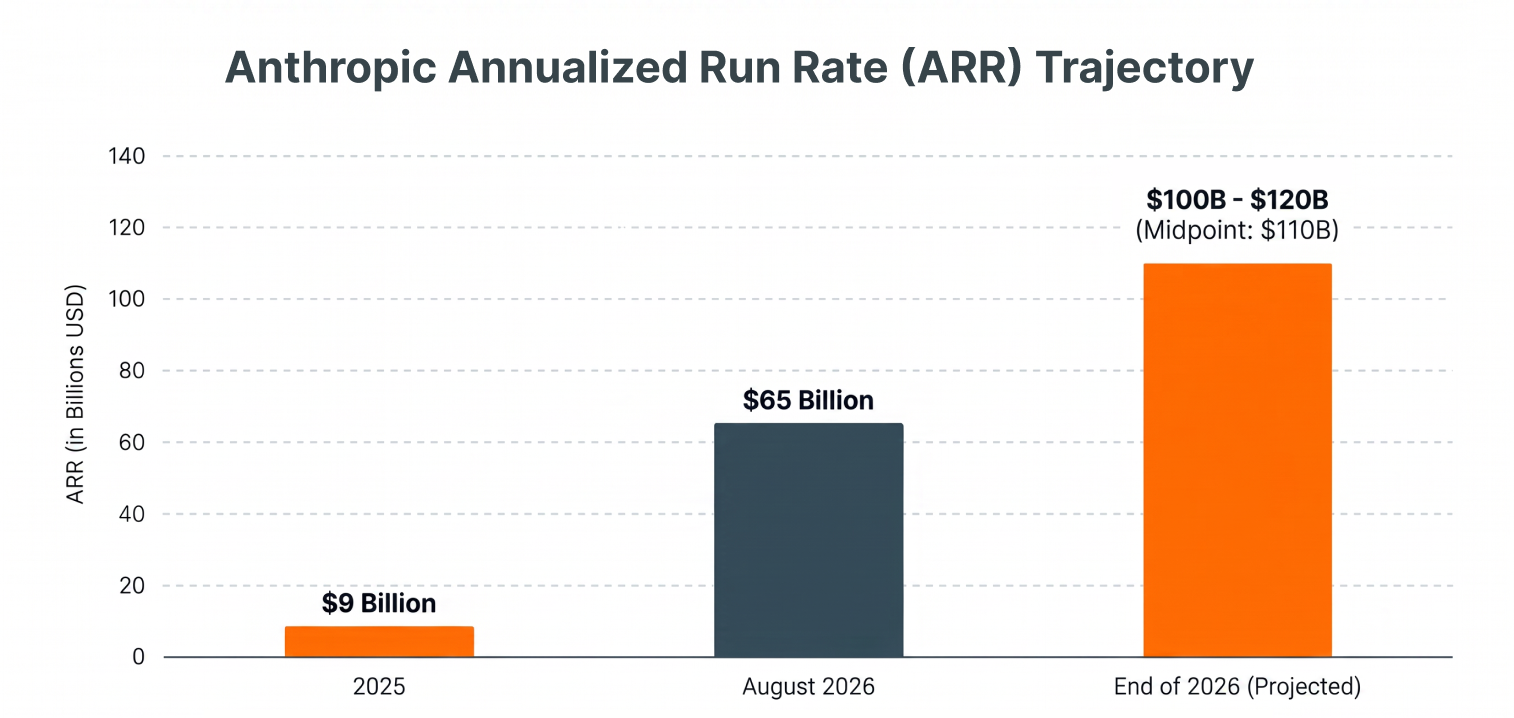 Source: TechCrunch, Anthropic's annualized revenue surges to $65B, as of August 17, 2026
Turning to CoreWeave, it generated revenue of $229 million in 2023, $1.91 billion in 2024, and $5.1 billion in 20252. So, it is also growing at a rapid clip.
This year, the company is guiding to revenue of $12.4 billion to $13.2 billion3. At the mid-point ($12.8 billion), that would represent growth of 150%.
Looking further out, Wall Street expects revenue to hit $26.3 billion in 20272. Clearly, analysts expect demand for the company’s AI compute solutions to remain high.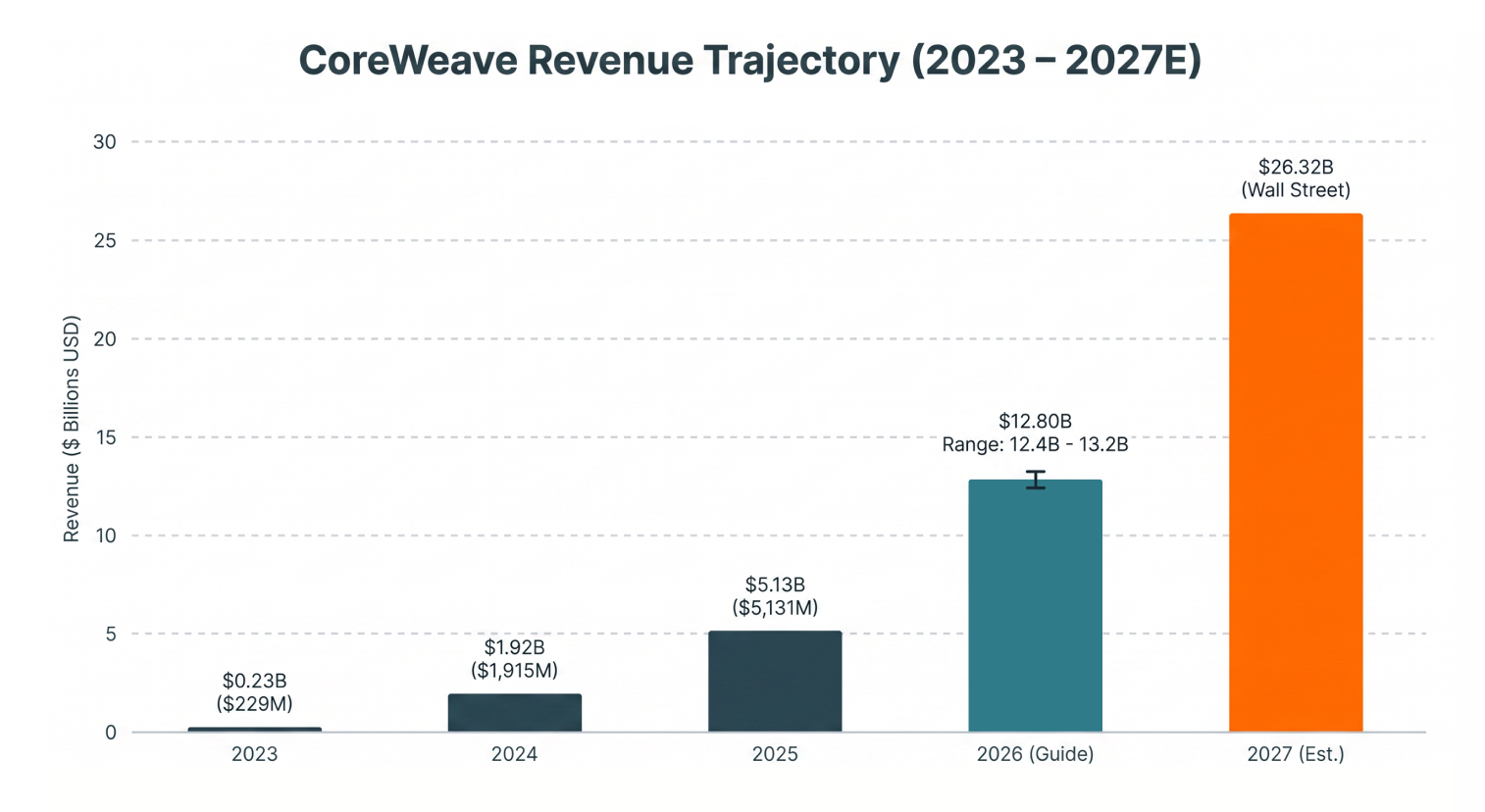
Source: LSEG, as of September 2, 2026, and CoreWeave, CoreWeave Reports Strong Second Quarter 2026 Results,
as of August 11, 2026
Competitive Moats
An analysis of Anthropic’s business model reveals several factors that point toward a strong moat:
Enterprise trust: Anthropic’s has a strong focus on AI safety, and this has enabled it to carve out a dominant position in the enterprise space, particularly within highly regulated sectors (finance, healthcare, legal), where data privacy and deterministic behavior are paramount.
Developer mindshare and coding dominance: Rather than competing purely on general AI consumer chat, Anthropic captured a dominant share of developer workflows (largely driven by Claude’s advanced context windows, reasoning, and code-generation environments like Claude Code).
Hyperscaler support: Backed by massive investments and compute partnerships with Amazon (AWS) and Google Cloud, Anthropic has deep distribution embedded directly into enterprise cloud platforms, giving it easy access to corporate buyers.
However, while Anthropic looks well positioned today, there are no guarantees that the company will continue to have success. For a start, frontier AI models face constant risk of commoditization. Secondly, the company is operating in a very competitive space, and it is up against some powerful tech companies. Rivals include Google, OpenAI, Microsoft, Meta, Amazon, Mistral AI, and DeepSeek.
As for CoreWeave, an analysis of its business model reveals several structural advantages that give it a moat:
Specialized high-performance architecture: Whereas legacy cloud providers built their data centers for traditional CPU-bound web workloads, CoreWeave has built data centers designed specifically for AI workloads.
Nvidia GPU access: CoreWeave has secured high-volume allocations of Nvidia GPUs and recently completed the industry's first bring-up and validation of the Vera Rubin NVL72 architecture3.
Massive backlog and revenue lock-in: As of June 30, 2026, CoreWeave had a revenue backlog of approximately $104 billion3 – roughly 20 times 2025 revenues.
Like Anthropic, however, CoreWeave operates in a competitive industry. Its rivals include hyperscalers such as Microsoft, Google, and Amazon, along with neocloud providers such as Nebius, Nscale, and Lambda. Looking ahead, its success will depend on its operational speed, power procurement, and hardware efficiency. If rivals offer cheaper compute, faster infrastructure delivery, or superior software integration, CoreWeave’s could be vulnerable to customer churn and margin compression.
Valuations
In terms of their valuations, neither AI company has earnings today, so it is impossible to calculate price-to-earnings (P/E) ratios. We can calculate price-to-sales ratios, however.
Starting with Anthropic, its market cap is expected to be approximately $2 trillion at IPO1. Taking the $65 billion ARR figure above, we get a price-to-sales ratio of about 31.
As for CoreWeave, its market cap is currently $45 billion2. Taking the mid-point of its 2026 revenue guidance, we get a price-to-sales ratio of approximately six, meaning that it is significantly cheaper than Anthropic on this metric.
Note that the average analyst price target for CoreWeave is currently $1442, which is around 75% above the current stock price. When Anthropic comes to the market, it’s unlikely that analysts will forecast that much upside given its high market cap and price-to-sales ratio.
Anthropic Versus CoreWeave
Putting this all together, both companies appear to have potential from an investment perspective. Both are growing rapidly and benefit from competitive moats.
Looking at their valuations, however, CoreWeave possibly has more potential. Ultimately, it is significantly cheaper than the AI lab.
Footnotes:
1TechCrunch, Anthropic’s annualized revenue surges to $65B, as of August 17, 2026
2LSEG, as of September 2, 2026
3CoreWeave, CoreWeave Reports Strong Second Quarter 2026 Results, as of August 11, 2026
Author is a contractor of Leverage Shares LLC, a U.S. affiliate of Themes Management Company LLC. Leverage Shares LLC provides certain services to Themes under an intercompany services agreement.