
Article by Violeta Todorova
Oil Shock and Middle East War Threaten Deeper Equity Pullback
March 12, 2026 | Research
Surging Oil Prices Cloud the S&P 500 Outlook
Global markets started the week on a cautious footing as escalating tensions between the United States, Israel and Iran pushed oil prices sharply higher. The sudden rise in crude has revived concerns that inflation could reaccelerate just as investors had begun positioning for a more accommodative monetary policy environment. As a result, energy prices have quickly become the key variable impacting market sentiment, prompting investors to reassess expectations for inflation, interest rates and global equity performance.
For the S&P 500, which has delivered a strong rally over the past year driven by optimism around artificial intelligence and expectations of future rate cuts, the escalation in Middle East tensions introduces a new layer of uncertainty. Should energy prices remain elevated, the market may face a more complex macro environment characterised by higher inflation, slower growth and the possibility that the Federal Reserve delays its anticipated easing cycle.
The Oil Shock Becomes a Key Market Driver
The war in the Middle East has rapidly positioned oil as the primary channel through which geopolitical risk is being transmitted to financial markets. Brent Crude briefly surged toward $120 per barrel on Monday, marking a rise of nearly 30% from Friday’s close.
The speed of the move has been striking. Over the past week alone, Brent Crude climbed almost 28%, while West Texas Intermediate (WTI) advanced more than 35%1. Price swings of this magnitude are typically associated with meaningful supply disruptions, rather than short-lived geopolitical flare-ups.
The magnitude of the rally shows that concerns over supply disruptions are spilling out beyond the Strait of Hormuz, which is one of the most critical chokepoints in global oil trade. Tanker traffic through the region has come to a halt last week, while several Gulf producers have reportedly reduced output2. Together, these developments have heightened fears that what initially appeared to be a temporary disruption could become a more prolonged energy shock, with broader implications for global inflation and financial markets.
Oil Price Spike Revives Inflation Fears and Pressures Bond Markets
The sharp rise in oil prices has quickly filtered through to global bond markets, prompting investors to reassess the outlook for inflation and monetary policy. Rather than benefiting from traditional safe-haven demand, government bonds have come under pressure as traders price in the risk that higher energy costs could delay policy easing.
The inflationary consequences of the recent oil shock are drawing concern from global policymakers. Kristalina Georgieva, the Managing Director of the International Monetary Fund (IMF), warned that the war in the Middle East could reignite global inflation if energy prices remain elevated.
According to the IMF, a sustained 10% increase in oil prices over the course of the year could add around 40 basis points to global inflation. This highlights that the global macroeconomic outlook remains highly sensitive to developments in energy markets3.
Yields on U.S. Treasury securities have moved higher across the curve, with the 10-year yield climbing from 3.92% at the start of the war to 4.25% on Thursday1. Before the start of the conflict, investors widely believed the Federal Reserve was getting close to a new easing cycle as inflation showed signs of moderating. The rapid surge in West Texas Intermediate (WTI) crude has complicated that outlook. If oil prices remain above $100 per barrel for an extended period, policymakers could face a difficult trade-off between supporting economic growth and preventing inflationary pressures from re-emerging.
The strong rally in the S&P 500 over the past year has been largely underpinned by expectations that inflation would continue to ease, allowing the Federal Reserve to gradually reduce interest rates. A renewed inflation shock could challenge this assumption and prolong the period of restrictive financial conditions.
Historically, energy shocks have often placed central banks in precisely this dilemma. Rising oil prices tend to filter rapidly into transportation costs, manufacturing inputs and household energy bills, creating a broad ripple effect that pushes inflation higher across the economy.
For equity markets, the primary concern is the potential emergence of stagflation, where slowing economic growth coincides with rising inflation. Sustained oil prices above $100 per barrel could weigh on corporate margins while simultaneously eroding consumer purchasing power, creating a challenging backdrop for equities.
Iran Conflict Threatens Global Oil Supply Despite Strategic Reserve Releases
Markets still appear to be underestimating the potential duration and operational disruption caused by the conflict. As geopolitical tensions move beyond the initial shock phase, oil markets typically transition from pricing short-term uncertainty to assessing how long producers can sustain output under increasingly difficult operating conditions.
Despite this, oil prices pulled back from weekly highs after several countries signalled plans to cushion potential supply disruptions. Reports indicated that the International Energy Agency is preparing a record release of 400 million barrels from strategic reserves. Meanwhile, Donald Trump announced the United States will release 172 million barrels from the Strategic Petroleum Reserve to help mitigate the energy shock linked to the Iran conflict.
However, the conflict with Iran shows few signs of de-escalation, despite repeated claims from U.S. officials that the war may be nearing its end. The situation has effectively erased the global energy surplus, leaving supply conditions far more fragile and increasing uncertainty around future oil prices.
S&P 500 Outlook Hinges on Oil Prices
The path of oil prices is likely to determine the direction of global markets in the weeks and months ahead. If energy prices retreat as geopolitical tensions ease, the recent volatility in equities could prove temporary.
However, if oil prices remain elevated in the $90–$100 per barrel range for an extended period, the macroeconomic backdrop could change significantly. Higher energy costs would increase the risk of persistent inflation, potentially delay interest rate cuts and place additional pressure on corporate earnings.
In that environment, the S&P 500 could face a deeper correction as investors reassess both market valuations and the broader economic outlook. For now, markets appear to be operating under the assumption that the conflict will not evolve into a prolonged supply disruption. Yet with energy markets already experiencing historic volatility, the margin for error is narrowing rapidly.
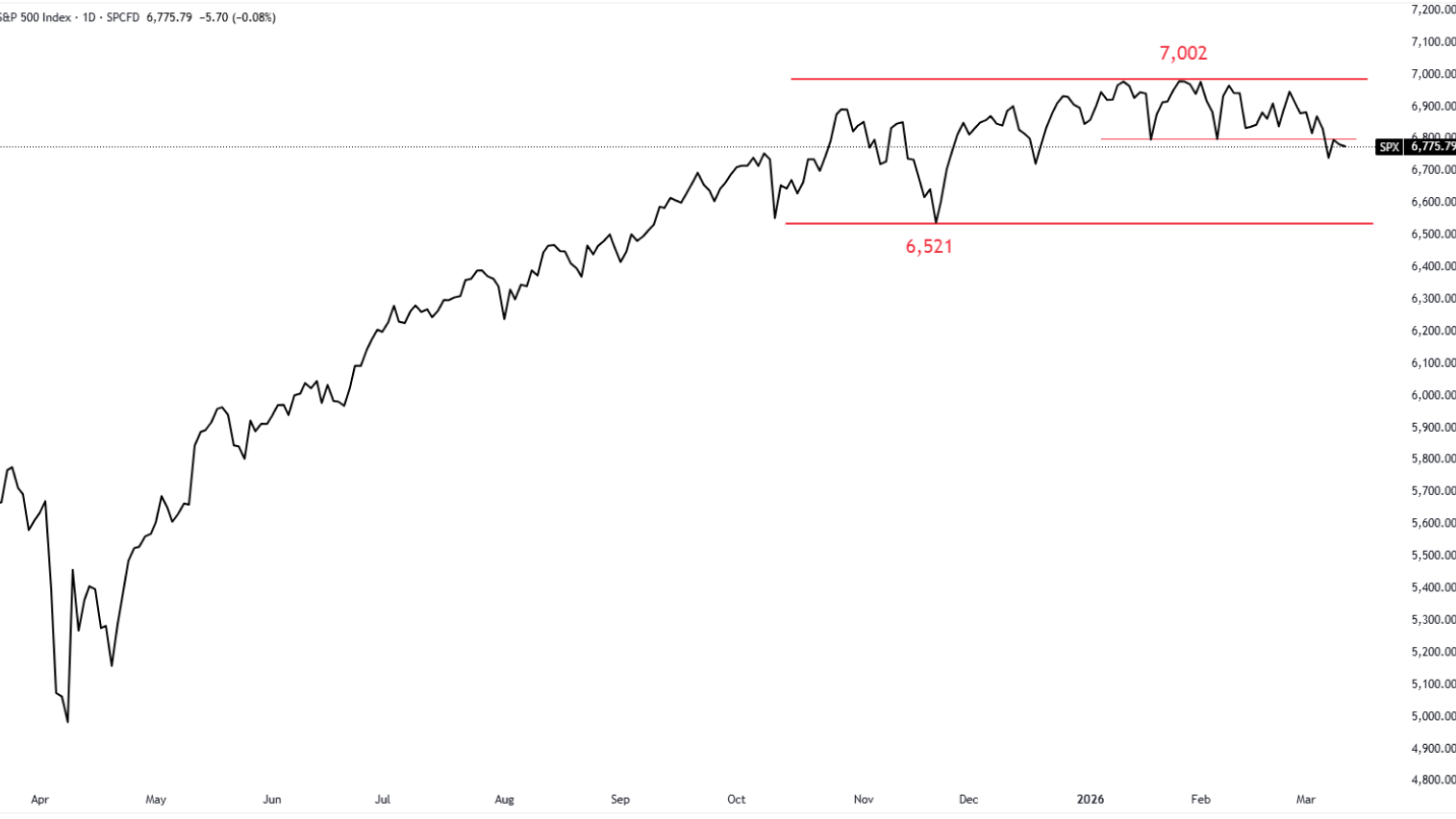
Source: TradingView, S&P 500 daily price chart, as of March 10, 2026
S&P 500 Faces Downside Risk as End to the Conflict Appears Unlikely
From a technical standpoint, the S&P 500 has broken below its key support level of 6,521, amid the sharp rise in oil prices and softer-than-expected economic data. A decisive break below this level would suggest a relatively modest correction towards 6,050 is likely to unfold in the weeks ahead. If macro risks begin to stabilize that level could potentially offer a buying opportunity.
At the same time, several early warning signals are beginning to emerge. Credit spreads have started to widen, semiconductor stocks are losing momentum after a powerful rally, and parts of the financial sector appear increasingly vulnerable to tighter financial conditions. Together, these developments suggest that while the headline index remains relatively resilient, underlying market breadth may be starting to weaken.
By targeting energy routes, military bases and regional infrastructure over time, the conflict could expand geographically and persist for months rather than days or weeks, increasing uncertainty for global markets. If the conflict persists, equity markets could come under significant pressure.
Several critical assets across the Gulf are now within range of potential strikes, including export terminals, pipelines and processing hubs that are vital to global crude flows. Energy corridors across the region remain particularly vulnerable. Facilities such as the Abqaiq oil processing facility and key pipelines that move crude from the Gulf to international markets could become targets if the conflict escalates further. Damage to such infrastructure would significantly reduce export capacity, quickly tighten global supply and potentially push WTI prices towards $150. In such a scenario, the 6,050 support level for the S&P 500 may come under pressure, with a decisive break potentially paving the way for a deeper retracement.
Footnotes:
1TradingView, Financial data as of March 12, 2026
2IEA: Oil Market Report, as of March 2026
3Central Banking: Iran conflict could drive global inflation higher, IMF chief, as of March 9, 2026
Author is a contractor of Leverage Shares LLC, a U.S. affiliate of Themes Management Company LLC. Leverage Shares LLC provides certain services to Themes under an intercompany services agreement.